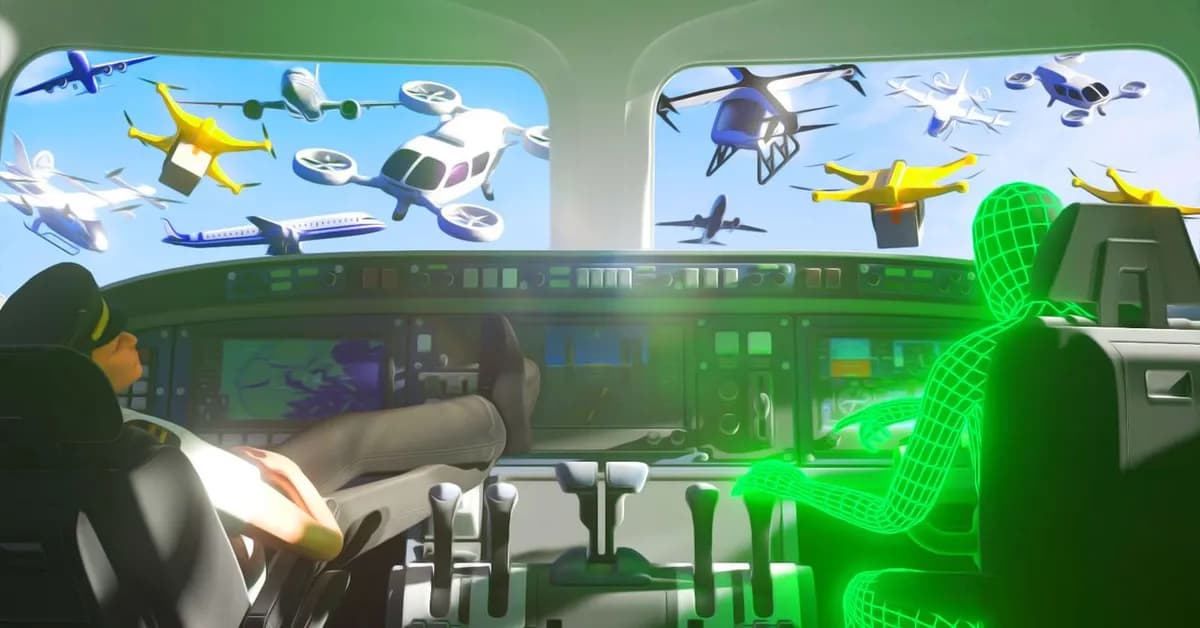
یک هواپیمای Cessna بدون سرنشین ۳۲۰۰ مایل پرواز کرد.
به نقل از Joby Aviation، این پرواز در سپتامبر ۲۰۲۴ انجام شد. سرنشین ایمنی حضور داشت اما واردکننده نشد. پرواز coast-to-coast بدون انسان کنترل شد.
پرواز بدون سرنشین: مسیر و جزئیات
- Buchanan Field Airport: Concord, California
- Phoenix: Arizona
- Fort Worth: Texas
- Shaw Air Force Base: South Carolina
- Dare County Regional Airport: North Carolina
هواپیما یک موتور تک طرفه بود. پرواز ۳۲۰۰ مایل در یک صبح آرام ستمبر انجام شد. مسیر پرتردد بود. هواپیما برای دور زدن طوفانها مسیر خود را تغییر داد.
The SMART System and Controller Shortages
SMART — Strategic Management of Airspace, Routes and Trajectories — از پیشبینی هوش مصنوعی برای تشخیص تناقضات برنامهریزی زودتر استفاده میکند.
FAA میگوید این سامانه جایگزین انسان نمیشود، بلکه کار کنترلرها را آسان میکند. مدیر Bryan Bedford گفت این ابزار با ارتقا سختافزاری میتواند تأخیر پرواز را کاهش و ترافیک را بهینه کند.
نظریههای مخالف میگویند سامانه ممکن است دادههای حیاتی را توهم کند. دو و بیست نماینده دموکرات از Government Accountability Office درخواست بررسی کردند. یک کارمند فارغالتخصص FAA آن را «جعبه Pandora» خواند.
SMART deployment timeline and controversy:
- September 27: Transportation Secretary Sean Duffy posted on X: «GAME CHANGER. Introducing SMART — the new air traffic management tool that saves YOU time, cuts back DELAYS, and makes your flying experience BETTER».
- Three weeks later (Friday the 13th): FAA issued a national groundstop that instantly threw airline schedules into chaos.
- FAA statement: No evidence of cyberattack, no sign SMART had anything to do with the communications failure.
- Homeland Security Secretary Markwayne Mullin on Friday night: «There's nothing certain right now» when asked if he could definitively rule out AI failure.
- October 13: Nearly two dozen Democratic lawmakers sent a letter to the Government Accountability Office requesting a review, citing fears SMART might «hallucinate safety-critical information».
- Retired FAA employee (anonymous): «This is the Trump/DOGE/Musk effect. They're pushing through all this new technology without any understanding of the complexity of the national airspace system».
Autonomous Passenger Flight Economics
Joby's S4 eVTOL aims to carry a pilot and four passengers 100 miles at 200 mph. Demo flights continue under the eVTOL Integration Pilot Program launched by the Trump administration in March. Next come non-paying passengers, then paying passengers, then commercial routes. All permitted under eIPP with increasing oversight. But economics demand autonomy: one pilot per few passengers is unsustainable. Self-flying aircraft face harder challenges than self-driving cars — a control failure at altitude is likely fatal.
Joby S4 development timeline:
- 2020: Joby unveiled S4 design — pilot plus four passengers, 100+ mile range, 200 mph top speed
- 2023: S4 maiden flight
- March 2024: Trump administration launches eVTOL Integration Pilot Program (eIPP)
- April 2024: First NYC point-to-point eVTOL flight (JFK to three Manhattan heliports)
- Additional demo flights: California and Texas under eIPP
- Next phases: Nonpaying passengers → paying passengers → commercial A-to-B routes
- Bowles (Joby): Demo flights are just the «front edge» of operational rollout; all phases permitted under eIPP with increasing oversight
Drone Delivery at Scale
Amazon plans drone delivery from 500 locations by year-end. Walmart targets 270 stores by 2027. The FAA began issuing beyond-visual-line-of-sight waivers in 2023 and may make the rule permanent this year. Anthony Vittone of DroneUp predicts hundreds of thousands of drones servicing most US households within a decade. Early Google Wing trials in Australia and Virginia proved operational feasibility, not profitability. The vision: ubiquitous aerial logistics for food, medicine, and parcels.
Drone delivery milestones:
- 2014: Google unveils Project Wing
- 2018: Wing ferrying food, coffee, medication to 164 homes near Canberra, Australia
- 2019: Pilot program expanded to Christiansburg, Virginia
- 2023: FAA begins issuing beyond-visual-line-of-sight (BVLOS) waivers for delivery drones
- 2024 (August): Amazon announces expansion to 500 locations by year-end
- 2027 target: Walmart plans drone delivery from 270 store locations
- FAA: May make BVLOS rule change permanent by end of 2024
- Anthony Vittone (DroneUp): «In five to 10 years, it's going to be completely ubiquitous. People are going to be, like, 'I don't know how I lived without it.'»
- Industry maximal vision: Hundreds of thousands of drones servicing most or all of US population
European Resistance and Regulatory Friction
In 2017, Airbus and Dassault asked EASA to approve single-pilot airliner operations with AI copilots. The European Cockpit Association protested fiercely, arguing automation would remove an independent safety professional. EASA shelved the plan. The conflict illustrates a global pattern: manufacturers push automation for economics, pilots and regulators demand redundancy. The FAA's conservative certification process remains a bottleneck for eVTOL commercialization.
Single-pilot controversy details:
- 2017: Airbus and Dassault petition EASA (EU equivalent of FAA) for single-pilot operations with automated systems as copilot
- Traditional requirement: Multiple pilots divide workload and provide redundancy if one becomes incapacitated
- Airbus vision: Automated systems shoulder copilot workload, take over entirely if needed
- European Cockpit Association protest: «Would remove an independent safety professional from the flight deck and give operators greater influence over the safety judgments that a pilot would otherwise make»
- Outcome: EASA shelved the plan
- Mary Schiavo: «Aviation regulation has been conservative and prioritizes reliability, because the consequences of failure are severe. Certification standards and airworthiness require proof and demonstrated safety, and that usually means incremental rather than radical change».
- Bowles: «It's a very important, safe, careful dance».
Dual Airspace Architecture Emerging
McCormick predicts AI will first control dedicated corridors near drone hubs and vertiports. Swarms of autonomous aircraft will overwhelm traditional human-controlled airspace. Two systems will operate side by side: human-controlled for conventional aviation, AI-managed for high-density robot traffic. This creates a real-time performance comparison. But hacking risks and hallucination risks remain. Without a human in the loop, obvious errors may go unnoticed until catastrophe.
AI airspace management details:
- First AI-controlled airspace: Select corridors near drone hubs and eVTOL vertiports
- Reason: Swarms of robot aircraft too numerous and complex for human controllers
- McCormick: «The objective is not to use traditional air traffic control, because it would overwhelm the national airspace system if it tried to handle that volume and complexity of airframes moving around».
- Dual system: Human decisionmakers for conventional aviation, AI for high-density robot traffic
- Real-time comparison: Two systems working side by side provide performance benchmark
- Risks: Any computer system can be hacked; AI creative enough to ideate novel solutions could hallucinate crucial details
- Without human in loop: Seemingly obvious mistakes might go unnoticed until too late خطر هک شدن سیستمهای هوش مصنوعی که در مدیریت ترافیک هوایی به کار میروند، نگرانیهایی را برانگیخته که الکس استاموس در مورد عصر تاریک امنیت سایبری هشدار داده است.
AI Tools Already in Use
Behind the scenes, AI already powers aviation software. Data companies and industry stalwarts sell AI-enabled tools for risk analysis and scheduling.
Current AI aviation software providers:
- Palantir: AI-enabled software for regulators, airlines, flight dispatchers
- Jeppesen: Aviation industry stalwart selling AI scheduling and risk-analysis tools
- Thales: AI-enabled software for airspace management
- Air Space Intelligence (Boston-based): Built SMART for FAA, deployed September 2024
- Function: Sift through masses of data to identify risks, plan aircraft and crew scheduling
The Regulatory and Technical Challenge
The stakes are existential for public trust. A single high-profile AI failure could set back autonomous aviation by decades. Yet the economic pressure is immense. The question is not whether AI enters the cockpit and the tower, but whether the industry's safety culture can adapt fast enough to validate it.
Key technical hurdles:
- Deterministic neural networks: Trained offline, weights frozen before deployment — cannot hallucinate but may harbor other risky failure modes
- Novel situation outputs: Cofer (2021) showed systems generate «unexpected (and potentially dangerous) outputs» in untrained scenarios
- Real-time ATC decisions: Higher stakes when AI makes real-time air traffic control decisions
- Certification standards: Require proof and demonstrated safety — incremental, not radical change
- Silicon Valley speed vs. aviation norms: Fundamental cultural conflict چالش اعتبارسنجی هوش مصنوعی در هوشبرداری، بحثهای گستردهای را درباره نیاز به حفاظهای قویتر ایمنی در میان کارشناسان دامن زده است.
The convergence of SMART's deployment, Joby's pilotless milestone, and mass drone expansion signals a tipping point. Aviation's «time-tested» philosophy is being stress-tested by venture-backed urgency. Regulators must decide if predictive AI meets the gold standard — or if the gold standard itself must evolve.
Watch the GAO review of SMART and the FAA's final rule on beyond-visual-line-of-sight drone operations. Both will shape whether 2025 becomes the year AI earns its wings — or the year the industry hits pause.
Jeff Wise is a New York–based science journalist specializing in aviation, technology, and psychology who contributes frequently to New York magazine. A cohost of the podcast Finding MH370, he was widely seen in the Netflix documentary series MH370: The Plane That Disappeared and executive-produced the Showtime documentary feature Gringo: The Dangerous Life of John McAfee.



گفتگو